

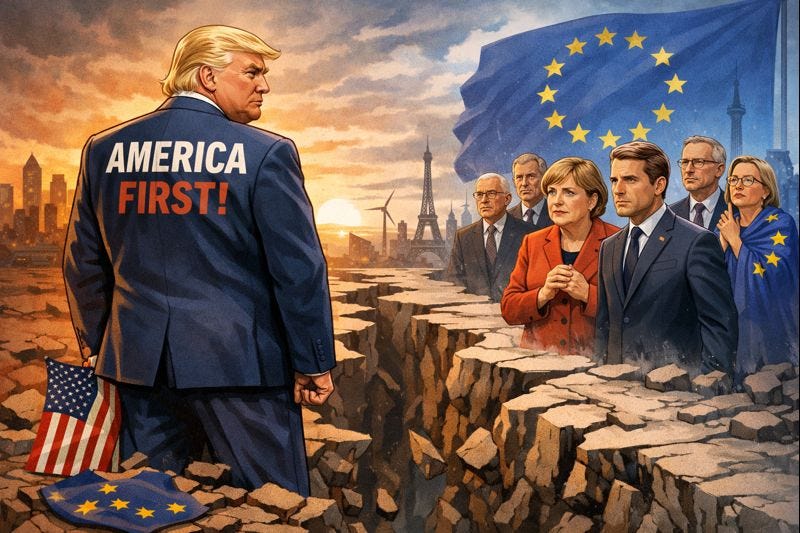
As we near the year’s end, two matters with major policy implications for international relations are still rattling around political and think tank minds – the Trump US National Security Strategy, and the warning of war with Russia from Mark Rutte, Nato’s Secretary-General. Let us take the US National Strategy first. There will be a piece later on the alleged war threat.
Because this is a Trump administration document whose foreword, signed by him, is full of bombast with paragraphs in the main body making false claims of him ending wars and bringing peace and stability to the whole world, it would be easy to dismiss it as another sycophantic exercise by his officials playing to his massive ego. It is more than that. It has serious implications for European security.
The Strategy Principles have a clear message from Trump for other countries in the next three years. It explains: ‘President Trump’s foreign policy is pragmatic without being “pragmatist,” realistic without being “idealistic,” muscular without being “hawkish,” and restrained without being “dovish.” It is not grounded in traditional political ideology. It is motivated above all by what works for America – or in two words “America First”’
The only thing new in “America First” is that it states an old consistent US policy openly, whereas in previous administrations of both colours it was clothed in soothing words of comfort for those who were useful to advancing US national interests. Europe should be grateful to Trump for spelling out that reality, and we here in Britain should, surely, at last, get the message that the “special relationship” is one in which only one side gains while the other, the UK, is delusional.
Trump’s brand of America First is consistent with the isolationist strand in that country’s thinking since its birth. It condemns “allies and partners” who free load on America and “sometimes suck us into conflicts and controversies central to their interests but peripheral or irrelevant to our own.“ It makes plan that “The affairs of other countries are our concern only if their activities directly threaten our interests.”
It puts the question ‘What Should the United States Want?’, and answers ‘First and foremost, we want the continued survival of the United States as an independent, sovereign republic whose government secures the God-given natural rights of its citizens and prioritizes their well-being and interests.’ That aim is to be achieved by making the USA strong economically, innovative and in the lead technologically, having a military with unsurpassed lethality along with strong soft power.
The Monroe Doctrine Plus
When it turns to the World it wants the rest to comply with America’s needs, especially those countries near-by in the western hemisphere who remain subject to the Monroe Doctrine. Which now has a Donald Trump add-on of “we’ll threaten and hit whoever we want whenever we want,” as Maduro in Venezuela is finding out. Not only is Venezuela threatened with a large fleet, its air space has been closed, with more than a dozen international airlines now ceasing to fly there.
A side effect of the blockade of Venezuela’s oil exports is the effect upon Cuba. Denied its 40% reliance on supply from Maduro, its economy is being brought to the brink of ruin. Cuba’s GDP has already shrunk by 15%, inflation is astronomical, and 2.7m active young people (25% of the population) have fled.
America First is not America Alone
But America First cannot be served in a world of 193 states of differing economic and military weight, some in strategic positions, by a policy of America Alone. Yes, there is that strand of isolationism, but the Trump National Security is not isolation. It recognises the need to maintain “a broad network of alliances, with treaty allies and partners in the world’s most strategically important regions.” In short, it is in the USA’s national interest to continue dominating the Indo-Pacific, and given the vast extent of that region’s landmass and oceans, that can only be done with allies located there. Step forward Japan and South Korea. And good old Australia, a valued ally.
Then there is the question mark about Europe
As for Europe, despite the obvious contempt the Trump has for what he sees as its woke-obsessed weak leadership, it is a region that has been in the US sphere of influence for 80 years, and the reasons for that have not changed. ‘Europe remains strategically and culturally vital to the United States’ because ‘Transatlantic trade is one of the pillars of the global economy.’ Which is why it states “We want to support our allies in preserving the freedom and security of Europe” but adding “while restoring Europe’s civilizational self-confidence and Western identity.” (my emphasis)
Here we come to the caveat on that “support.” Viewed from the White House, Europe is not dependable. It is in danger of ‘civilizational erasure,’ by undermining ‘political liberty and sovereignty, migration policies that are transforming the continent and creating strife, censorship of free speech and suppression of political opponents, cratering birthrates, and loss of national identities and self-confidence.’ Then comes the warning: ‘Should present trends continue’ and Europe become ‘unrecognisable in 20 years’ then it is questionable whether some countries will ‘remain reliable allies?’ That places an implicit question about US forever engagement with Nato. A view that has gripped and made anxious, Europe’s present leadership.
But all is not in America as Trump sees it
This is the Trump outlook on Europe, and may remain the long-term policy. But that will depend not only on who the Republican nominee is for the 2028 election, and if he will win. The assumption at present is that J D Vance will be the nominee, and continue the Trump policy to the letter. But if it is Vance, he will need more than the isolationist tendency to become President. He will have to take into account what Americans actually believe is in the interests of their country, and how it relates to the rest of the world. They don’t line up all the way with Donald J Trump.
Consider first an important segment of the American people – the elected Senate. With worry in the air about Trump’s hostile attitude to Europe, Republican and Democrat Senators together- by 77 votes to 20 - in December, pushed through The National Defence Authorization Act, described as a push-back against the administration. It deliberately makes it hard for the White House to withdraw any US troops from Europe, or relinquish the top military command position in Nato. Legal salt on the Trump tail.
A number of those Senators will be up for re-election next year. All Senators, along with House members, don’t do Trump-style rallies; they do town hall meetings where they listen and pay close attention to public opinion expressed there, also in their emails, and the opinion polls.
The Reagan Institute, far from a democrat organisation, has been polling on US foreign policy for years. Its latest polls show 68% of Trump voters view Nato favourably. 76% would support USA military force if a Nato ally is attacked. The majority of Americans, 59%, oppose leaving Nato. Among those not in favour of Nato, a significant number, 25%, change their attitude when told European members of the alliance have agreed to shoulder more of the financial costs.
Nor do the polls show the people lining up with Trump’s peculiar view of the Russian-Ukraine war. By 62% to 11% Americans want Ukraine to win, and 68% support selling weapons to Europe to pass on to Ukraine. When Republicans alone are polled on that, the support is 75%. While it is difficult to discern if Trump really trusts Putin to honour any peace deal, 70% of Americans do not.
The polls show entrenched views on the desire for allies. These views are unlikely to change in the coming mid-term election year, which is also when aspiring presidential candidates begin to fashion their campaign policies. It is an open question, therefore, whether Trump’s National Security Strategy will figure prominently in Republican campaigns as a vote winner.
Trump is leaving a long-term Nato legacy Europe cannot ignore
It would be foolish however for Europeans to take too much comfort from those polls, and ignore the long-term impact of one important Trump policy – European share of Nato’s cost. Other Presidents have complained about other members of Nato not pulling their weight financially, and piggy-backing on America, but did nothing. Trump has been different.
He has called out the Europeans, demanded, not asked, that they take a bigger share of Nato’s financing; and there is in the National Security Strategy a hint that if they back-track on their spending pledges, the 5% of GDP, then the “support” that has been there in the past may not be there in the future.
Europe must grasp that this“Nato cost”factor is now permanent in the American mind. Trump has set a high bar on how American Presidents in future are going to judge the worth of European allies within Nato, whatever the colour of the administrations.
Good analysis, Jim. See my response to NSS on
https://labourhub.org.uk/2025/12/18/trump-declares-europe-public-enemy-number-one/
And all the best for the New Yera
Read Chapter 7 of Jim Sillars new book. Absolutely ludicrous!