

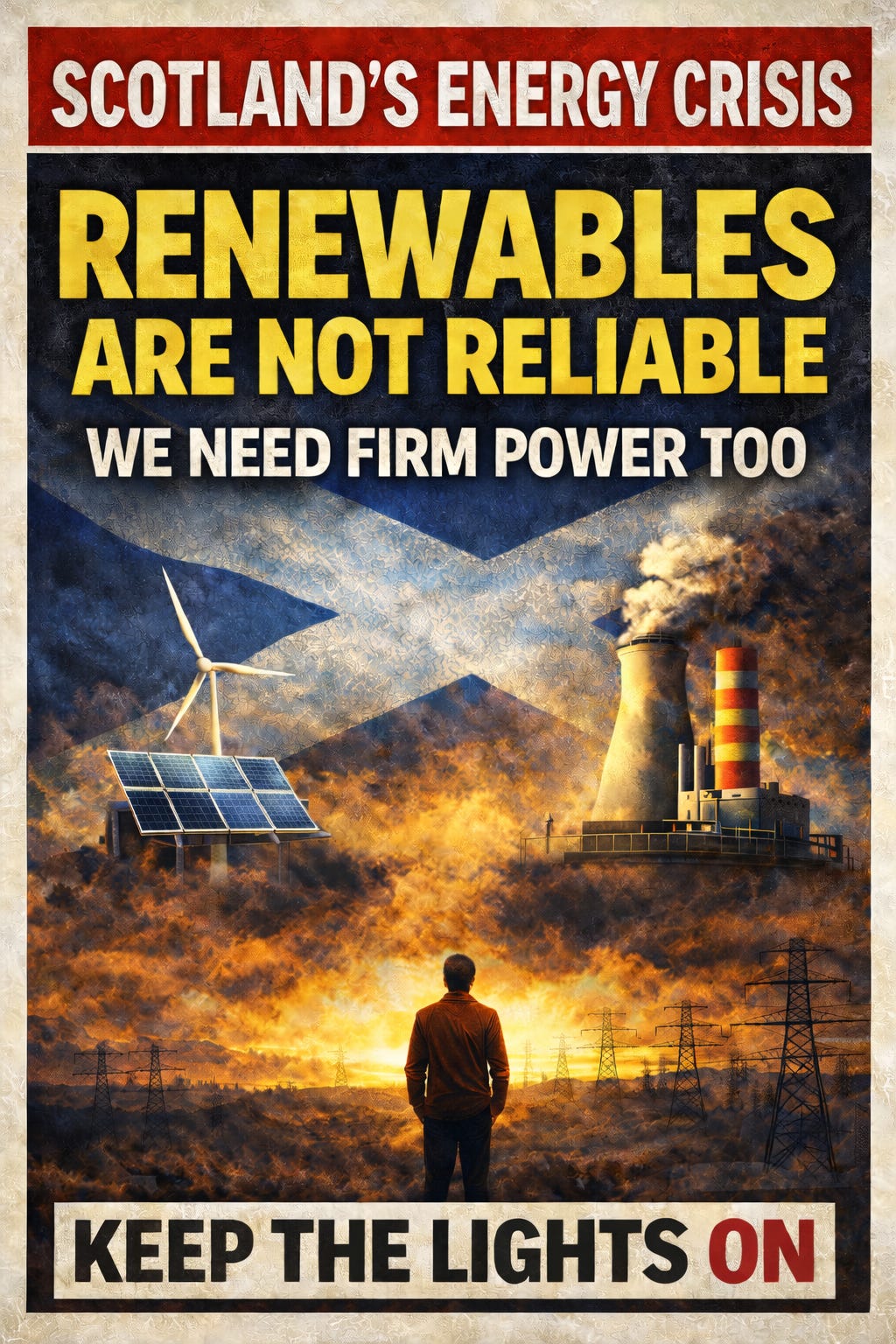
There was a time when energy security was simple.
Fuel arrived physically. Coal was stacked in the cellar. If you had fuel, you had heat. Capacity meant what was available when you struck a match.
Today, the word capacity means something very different in Scotland’s energy debate and that shift in meaning is at the heart of a growing policy problem.
When ministers boast that Scotland has nearly 20 gigawatts of generating capacity - rising potentially to 40 gigawatts by 2045 - it sounds like abundance. Given that Scotland’s peak electricity demand today is only around 4 gigawatts (and perhaps 9 gigawatts by mid-century), the numbers suggest a nation awash with power.
But installed capacity is not the same thing as reliable supply.
Capacity vs Reality
Installed renewable capacity represents the maximum output under favourable conditions. It tells us what wind farms could produce in strong winds, not what they will produce on a still winter evening.
On many days, only 35–40% of theoretical wind capacity is realised. During prolonged low-wind periods - the so-called Dunkelflaute events seen across northern Europe - output can fall dramatically for several consecutive days.
Electricity systems must be designed around worst-case conditions, not average days.
That brings us to the uncomfortable question: how much of Scotland’s generating capacity is actually firm - capable of delivering power reliably, regardless of the weather?
Today, firm thermal generation consists largely of Torness nuclear station (around 1.3 GW) and the Peterhead gas plant (around 1.2 GW). Short-duration storage and pumped hydro add flexibility, but they cannot sustain output for multiple days at national scale.
In practical terms, Scotland has roughly 2.5 gigawatts of firm generation against peak demand of 4 gigawatts. The gap is managed through imports from the rest of Great Britain and through interconnectors that move power south when Scotland has surplus and north when it does not.
This is not energy independence. It is system balancing and dependency on our neighbours.
The Storage Gap
Much hope has been placed in battery storage. Scotland now has around a gigawatt of grid-scale battery power capacity installed, with more planned. But batteries typically discharge for one to two hours at full output. They smooth volatility; they do not provide long-duration backup.
To illustrate the scale of the challenge: a three-day winter low-wind event at 4 gigawatts of demand would require roughly 288 gigawatt-hours of stored energy. Scotland’s current battery storage holds only a tiny fraction of that.
Hydrogen has been promoted as the long-term solution — using excess wind power to produce hydrogen via electrolysis, storing it, then converting it back into electricity when needed. But round-trip efficiency is typically only 30–40%. Most of the original electricity is lost in conversion. Hydrogen may have industrial uses, but as bulk electricity storage it remains expensive and inefficient. Consequently, none of the fabled 300,000 hydrogen jobs, promised by Scottish Minsters in 2023, are on the horizon.
Renewables do not eliminate the need for firm generation but the Scottish Government is energy blind to this fact.
Exporting Power — and Curtailment
Scotland is frequently described as producing “more electricity than it needs”. Annually, that is true. But electricity must be delivered when and where it is required.
Interconnectors currently allow several gigawatts of transfer capacity to England and Northern Ireland, with major expansions planned by 2030 and beyond. Without them, much more wind generation would have to be curtailed — paid to switch off because the grid cannot absorb the surplus.
Constraint payments have already become a material cost in the British electricity system. Consumers ultimately bear those costs.
Meanwhile, hundreds of thousands of Scottish households face fuel poverty. The paradox of paying generators to reduce output while families struggle with energy bills ought to be politically unsustainable.
The Question That Matters
The central issue is not whether Scotland has abundant renewable resources. It clearly does.
The question is whether Scotland’s energy strategy adequately distinguishes between:
Installed capacity
Average generation
Firm, weather-independent supply
A system can have vast theoretical capacity and still face reliability risks during adverse conditions. Headline gigawatt numbers are not the same as security.
As nuclear stations age and gas faces political and regulatory pressure, the amount of firm generation on the system is likely to shrink unless deliberate policy choices are made to replace it.
Energy security requires clarity about trade-offs. It requires honest accounting of storage limitations. It requires planning for worst-case conditions, not just average ones.
Scotland’s energy future should be built on engineering realities rather than comforting arithmetic.
Capacity matters - but reliability matters more.
Transferring power between the nations on the basis of need, and helping out our fellow Britons seems a wonderful concept to me.. Why, it’s almost socialism! Jim would approve! We voted to keep the UK, so between us we have sufficient energy.
It sounds that we are in need of a 'Doldrums Strategy' - what do we do to generate energy when the wind doesn't blow.
In addition it seems we need the equivalent of a combi-boiler in order to access instant hot water rather than having to set a fire, stoke it and wait for it to heat up a whole conventional boiler (from bottom to top).