
NOT SO MUCH EPIC FURY AS EPIC FOLLY
Trump let loose a tide of consequences

On Friday 27th February the Islamic Republic of Iran’s position, anchored in Supreme Leader Ali Khamenei’s Fatwa, was that it would not build a nuclear weapon; the Iranian leadership, one of considerable experience and authority, had the Iranian Revolutionary Guard Corps under political control; the Strait of Hormuz was open to all maritime traffic; Dubai was booming; Qatari gas was travelling towards its usual customers; the other Gulf States were safe places; the world’s farmers’ fertiliser was loaded on ships; oil tankers were set for delivery at a stable price; poor Indian street tea sellers were picking up their small gas canisters; and 120 young children who attended the hajareh Tayyebeh Elementary School were alive.
That stable situation in the Gulf and its trade of oil, gas and fertiliser with the world was upended when Netanyahu persuaded Trump to join in an unprovoked attack on Iran on the 28th February, with assassinations (murders) of Iran’s top political and military leaders (137 of them) and a massive air bombardment. Those 120 children were among its first victims. The poor Indian tea sellers had no gas canisters. The Strait has closed to most ships. The oil price has bounced up and down, and up again. Gulf states have been battered. The whole world economy was placed in trouble.
Israel’s reasoning for launching the war was plain: destroy the regime, cut permanently its links with Hamas, Hezbollah and the Houthis, blocking its road to a nuclear weapon, and neutering any future Iranian government’s ambition as a regional power.
There was, and remains, confusion about why the United States joined Israel in the war. A string of reasons have flowed from the mind and mouth of President Trump: to give the Iranian people the chance to rise up and liberate themselves from a nasty regime, to eliminate its ability to acquire nuclear weapons, the regime to disappear with unconditional surrender, end its control of its proxies in Gaza, Lebanon and Yemen – one or all of them to be accomplished by pulverizing Iran’s military capability. It was all to be done and dusted in five or six weeks.
Here we are in August. Ali Khamenei’s Fatwa declaring it un-Islamic for Iran to build a nuclear weapon dead along with him, the question of its nuclear material no longer the frontline issue, the most radical level of the Iranian Revolutionary Guard Corps controlling policy; 1,500 ships stuck in the Strait of Hormuz, with passage for most in the gift, at a price, of the IRGC; world oil reserves low as we head for winter; the Houthis strangling the Red Sea alternative passage for Saudi oil; and the Arab Gulf States terrified that a boxed-in Trump will see him lose the plot, seek to destroy Iran’s civilisation, with them paying a price that will devastate their societies’ basis of existence – oil and above all, water.
“Those who wrap themselves in the American flag are naked”: deposed ally of America Hosni Mubarak
It would be madness for Trump to carry out the threat he made months ago to utterly destroy Iran. The IRGC, not able to hit directly at American soil, would bring its Gulf allies tumbling down along with them by the destruction of desalination plants. All Arab Gulf states relay on desalination. Kuwait (pop. 5.7m) and Qatar (Pop 3.2m) are 90 per cent reliant on desalination for drinking water. Saudi with a population of 32.5m is 70 per cent dependent. “Humanitarian crises” would not describe the consequence of desalination destruction. That’s the message the hotline between the Saudi Crown Prince and Trump carried a week ago. Trump seems to have digested the message, as the new tactic from the White House is to intensify economic pressure on Iran by America blocking Hormuz thus denying its oil export profits (last week it was the US military that attacked a Panamanian vessel trying to exist the Strait).
The hard fact now is that while the United States has not been defeated militarily, its military muscle has been depleted with over six months’ worth of missiles expended in six weeks, with its re-supply system found inadequate. Not being defeated militarily in the sense that most of its seaborne task forces remain intact, is not the same as not being defeated politically: something that is now a distinct possibility for Trump unless he can find a new way to bring the regime to capitulation, or find compromise with the Iranian regime that he can sell as an accomplishment that was worth the money spent, the lives lost, and high cost of gas in US cars over past months.
A consequence: A harder line regime in Iran - harder but not stupid
Trump’s problem on that outlook is that he is reliant on the new Supreme Leader and the IRGC caving in as its economy sinks further and the US blockade of Iranian oil shipments from the Strait means, as Trump claims, the regime is “running out of money.”
But while there is no doubt that Iran’s economy and the standard of living of its people is under enormous pressure, the new Supreme Leader’s changes to regime leadership, little noticed in our media, signals the very opposite of capitulation or any moderating of its position on the Strait, or on its demands for massive reparations.
Mohsen Rezaei, former commander of the IRGC promoted to head the Supreme National Security Council; Brig. General Ahmad Vahidi, strongly opposed to any concessions to the USA, now head of the IRGC, and Hossein Taeb, formerly of the IRGC navy, now commander of the Basij, the so-called voluntary force used to suppress the population.
Nor has much attention been paid here that, in concert with those changes to a harder line regime, elements of the Iranian media have been viciously attacking the Iranian officials who negotiated the Memorandum of Understanding as selling out Iran. In what has been developing as a “who blinks first” contest, the regime seems to understand America and its politics better than Trump and his core group understand Iran. Put brutally, Trump and his Republicans need votes from an electorate that is hurting on the cost of groceries, and can punish them by a revolt in the ballot box in November, while the Iranian regime, having strengthened the Basij with even harder leadership than before, makes a successful citizens’ revolt most unlikely.
Those Iranian “Crazies” as he wrongly described them know Trump and his Republicans have cause to be worried. The mid-term elections are now under way. Donald’s approval rating on his own polling is down to 34%. He is telling lies that the Iranians are taking pleasure in revealing. On Tuesday 12th August Trump claimed the US had “total control” of Hormuz. The Iranians pointed out that of 14 vessels which exited the Strait on 11th August, 11 did so through the Iranian designated lane. A former US intelligence officer summed up the dilemma for Trump: “no good options, only bad ones.”
The lack of good options for the United States lies in the personality of Trump and the lack of guts among Republicans in Congress. Trump cannot admit to himself any failure on his part. Losers are other people, not him. Things not going right for him are the fault of the Europeans for not joining his war. The same now applies to the South Koreans; and for some reason he is now threatening to “bomb the shit out of Oman”. This man, this child-man, is now an obvious danger to the short and long-term interests of the United States – a danger that is in full view. Yet, the Republicans who can bring him to heel will not act.
Other Consequences: World growth flattened and a free plus for China
So far, states dependent on Gulf oil and gas have avoided sharp economic downturns by using their reserves, but these are now running low. If Hormuz is not fully open soon the full effect of no oil, gas and fertiliser from the Gulf will drive up prices of those resources from what is available from other regions, and high inflation, producing higher interest rates, will flatten world growth. The poorest countries and the poorest people will pay the price with growing hunger.
There is another consequence so far not noted, again with a downside to the international standing of the USA: the much vaunted “locked and loaded” military superpower is not so super as all were meant to believe. Trump and Hegseth boast of having destroyed Iran’s navy, but must place their aircraft carrier task forces a long way from Iran to keep them safe.
But even at a safe distance they are not free from difficulties as has been evident with the carrier Lincoln in recent weeks. As the Acting Secretary of the Navy has explained to War Secretary Hegseth: “Lincoln’s extended deployment raises broader questions about the Navy’s ability to sustainably generate carrier forces while preserving service member well-being, maintenance schedules, fleet readiness, and the capacity to respond to future contingencies.”
The Wall Street Journal put it more succinctly: “The underlying problem is that the U.S. burns naval power faster than it produces it…A stressed carrier force is a sign that the U.S doesn’t have sufficient naval assets to cover its interests around the globe.”
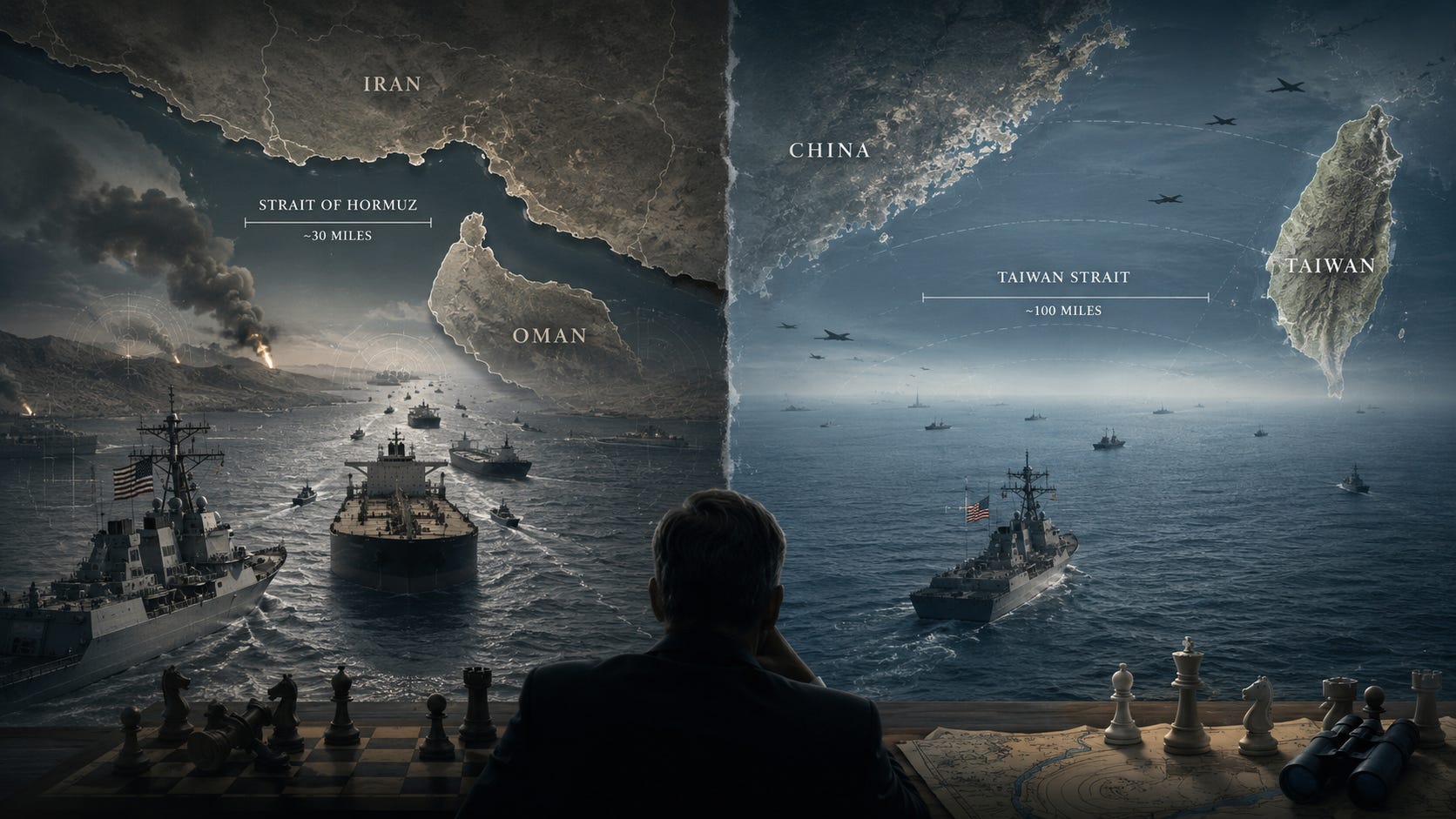
Who will take most note of that? China. But not that alone. China, from its spy satellites and information from its friend Iran, will now have valuable real-time battlefield intelligence on how America conducts war, which weapons it uses, how they perform offensively and in defence, why the carriers have to stay so far from the enemy, and the problems that have emerged over that vital factor, the logistical supply chain. The insight gained is something far better for China’s military planners than any war-game can provide. The Strait of Hormuz is 35-60 miles wide. If that seaway between the US task force and its enemy territory creates issues of carrier task force safety, just think of the problems the 100-mile seaway between mainland China and Taiwan will pose to the American Navy, if Taiwan is blockaded or attacked by China, which has a bigger navy and military power beyond anything Iran has ever deployed. The long-term price of Trump for the USA is huge.
PS: Another consequence no one seems to have grasped
The assassination of the head of state or government by another state has hitherto been taboo in modern times, for the very good reason that if once such action became normal it would be open season on all leaders.
Assassination of lower levels happens. Israel is a past master at that game. America has taken out terror leaders, but abandoned the high leader assassination long ago when the CIA was discovered to have had a few attempts on Fidel Castro.
That taboo dissolved when Israel and the USA together deliberately, as a matter of high policy, killed the head of state of Iran.